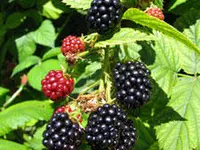
Apache Blackberry
1 Year Old
$4.95
Ships: 12/15/2026 - 04/15/2027
Description
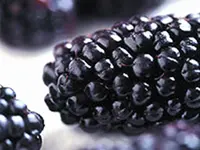
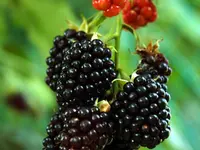
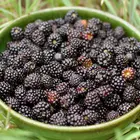
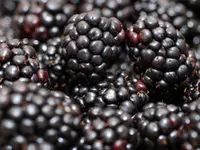
This excellent University of Arkansas introduction produces large berries on vigorous erect canes. The thornless canes grow erect and sturdy, maturing to roughly 5 to 8 feet tall and 4 to 8 feet wide. Apache Blackberry Plants exhibits strong resistance to Orange Rust and Cane Anthracnose, making it highly adaptable to regions with cool, wet weather. Our Apache Blackberry Plants are highly productive often with yields from 5 to 7 pounds of top-quality sweet, delicious fruit per plant. Grow in full sun to maximize fruit sweetness and yield.
Characteristics
| Bloom Color | Primarily white, often light pink |
| Bloom Time | Mid to late Spring |
| Fruit Color | Black Glossy |
| Fruit Size | Large |
| Hardiness Zone Range | 5 - 9 |
| Pollination | Self Fertile |
| Ripens/Harvest | Late June to July |
| Shade/Sun | Full |
| Soil Composition | Well-drained loamy or sandy loam soils high in organic matter. |
| Soil Moisture | Consistent deep watering once or twice a week after establishing. |
| Soil pH Level | 5.5 to 6.5 |
| Taste | Sweet and Delicious |
| Texture | Firm |
| Years to Bear | 2nd Year (Floricane) |
Pricing
| Size | Price | Ships |
|---|---|---|
|
1 Year Old
|
$4.95 | 12/15/2026 - 04/15/2027 |
|
10 Plants (1 Yr.)
|
$44.95 | 12/15/2026 - 04/15/2027 |
|
2 Year Transplant (Fruiting Size)
|
$15.95 | 12/15/2026 - 04/15/2027 |
|
10 Plants (2 Yr. Fruiting Age)
|
$144.95 | 12/15/2026 - 04/15/2027 |
|
+/- 2' Pruned (Instant Orchard Size)
|
$22.95 | 12/15/2026 - 04/15/2027 |
Zones
USDA Hardiness Zones
A hardiness zone is a geographic area defined as having a certain average annual minimum temperature, a factor relevant to the survival of many plants. In some systems other statistics are included in the calculations. The original and most widely used system, developed by the United States Department of Agriculture (USDA) as a rough guide for landscaping and gardening, defines 13 zones by long-term average annual extreme minimum temperatures. It has been adapted by and to other countries (such as Canada) in various forms. A plant may be described as "hardy to zone 10": this means that the plant can withstand a minimum temperature of −1.1 to 4.4 °C (30 to 40 °F).
Grows in zones: 5 - 9
This product grows in your zone!
A hardiness zone is a geographic area defined as having a certain average annual minimum temperature, a factor relevant to the survival of many plants. In some systems other statistics are included in the calculations. The original and most widely used system, developed by the United States Department of Agriculture (USDA) as a rough guide for landscaping and gardening, defines 13 zones by long-term average annual extreme minimum temperatures. It has been adapted by and to other countries (such as Canada) in various forms. A plant may be described as "hardy to zone 10": this means that the plant can withstand a minimum temperature of −1.1 to 4.4 °C (30 to 40 °F).
More Information
Health Benefits: Blackberries are packed with vitamin C. Just one cup of raw blackberries has 30.2 milligrams of vitamin C. ...They're high in fiber. A great source of vitamin K. High in manganese and may boost brain and oral health.
Wildlife Benefits: Black bears, foxes, coyotes, raccoons, opossums, voles, and mice forage and readily consume berries. Gamebirds, songbirds, and woodpeckers all feed on the berries.
Origin of species: Blackberries are native to several continents, which includes North America, Asia, Europe, and South America.